
Analysis of 146,324 students and 184,897 applications finds institutional process, not just outside barriers, shapes who makes it abroad
VENICE, FL / ACCESS Newswire / August 25, 2026 / Via TRM today released the 2026 Market Report: The Untold Story of the Study Abroad Student Journey, the first large-scale behavioral study of what happens to students between the moment they express interest in studying abroad and the moment they either go or quietly disappear. Much of the loss, it turns out, happens inside the process institutions themselves control.
The field has spent decades working to grow participation, and for a long time it worked. Growth in U.S. study abroad ran in double digits through the late 1990s. Then it flattened, years before COVID. In each of the five academic years leading up to the pandemic, growth never once exceeded 4%, and in the last of them it was 1.6%. The field rebounded after the pandemic, but in 2023-24 participation remained 14% below its 2018-19 peak-roughly where it stood a decade earlier.
Nearly every strategy aimed at reversing this has been built on what students say they want. Almost none has examined what students actually encounter: the applications, the approvals, the handoffs, the waiting. This report is the first look at that machinery at scale, and it asks a question the field has mostly avoided. Does the process we built help students get abroad, or does it get in their way?
Among the findings:
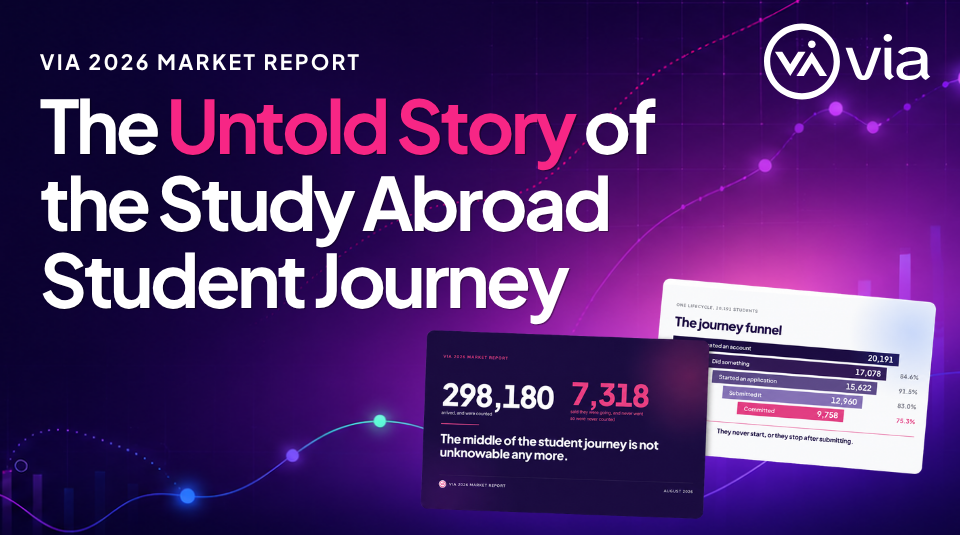
Of 16,128 students who said they were highly likely to travel, 7,318 never got there. 2,602 of them said cost was not a barrier. High intent, no stated financial obstacle, and they still did not make it.
74,407 applications were started and never submitted, and nothing in the process records why. The single largest loss anywhere in the journey, and the one the field has the least visibility into.
Provider approval starts a second application no one on campus can see. Those students wait 42 days from approval to commitment, against 14 across all programs. They clear review more easily than everyone else, at 83.6% against 79.4%, then lose fifteen points at the stage right after it. Approval looks like the finish line in the campus record. For the student it is a handoff.
48.5% of students act the same day they sign up. 9.1% take more than six months. Most offices run one communication sequence, built for a student who moves fast. The slow group is not lost. They are just being talked to on someone else's schedule.
Conversion ranges from 3.2% to 97.2% across institutions running the same platform. The middle half alone spans 29 points. Some of that is genuine difference in practice and some is difference in how offices record their work, which means there is no field average worth benchmarking against.
Cost has been the field's answer for as long as anyone has been asking the question. The data confirms it is a real barrier. It does not account for everyone.
"For years we have talked about the barriers to study abroad as though they all sit outside our offices. Cost, curriculum, family, geopolitics. Those are real, and they matter," said Dave Saben, CEO of Via TRM. "But this is the first time we can see how much our own processes, procedures, and logistics shape who actually gets there. The administrative work we do is not neutral. It plays a massive role in the outcome, and now we have the data to say so."
"This is why I was excited to join the Via team," said Brooke Roberts, SVP of Global Strategy at Via TRM. "I knew they were sitting on critical, but unseen data that could fill a huge gap in our understanding of the student journey. This is a first baseline, not the final word and that's exactly what the field needs to start asking harder questions."
The 2026 Market Report and the launch event replay are available now at https://www.viatrm.com/study-abroad-report
Methodology
Findings are drawn from aggregate, anonymized behavioral data on the Via TRM platform: 146,324 students, 438,294 recorded actions, and 184,897 applications across more than 200 institutions and 14,470 programs during the 2025-26 academic year. A second view follows 20,191 students individually, each observed for a full year from the day they created an account. Behavioral outcomes are drawn from activity recorded on the Via TRM platform. Where indicated, the analysis also uses students' responses about travel intent and perceived barriers to examine how their stated intentions correspond with subsequent behavior. Participation figures are from IIE, Open Doors Report on International Educational Exchange, U.S. Study Abroad for Academic Credit Trends, 1989-90 to 2023-24.
About Via TRM
Founded in 2012, Via TRM is the all-in-one operating system for global engagement. More than 250 institutions run education abroad, international student services, travel, and partner agreements on Via TRM. Learn more at viatrm.com.
Media Contact
Nicole Neese
Via TRM
Marketing Manager
nicole.neese@via-trm.com
SOURCE: Via TRM
View the original press release on ACCESS Newswire