
How three different platforms are shaping the future of community-driven market analysis
The Rise of Community-Driven Trading Research
The way traders discover opportunities has changed dramatically over the past decade.
Instead of relying exclusively on broker reports, financial news websites, or proprietary research, traders increasingly use platforms where market participants openly share charts, forecasts, technical analysis, and trading setups.
Among the most prominent platforms in this category are TradingView, TakeProfit, and the recently launched Trading Ideas section on MetaTrader.com.
Although all three enable traders to exchange market insights, they differ significantly in terms of community structure, content format, market coverage, and overall research workflow.
At a Glance
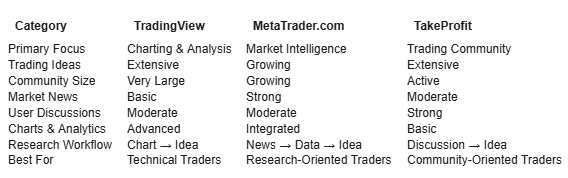
TradingView: The Largest Trading Ideas Ecosystem
TradingView has established itself as one of the largest online communities for traders and investors.
Its Trading Ideas feature allows users to publish chart-based analysis covering virtually every major asset class, including:
Stocks
Forex
Cryptocurrencies
Commodities
ETFs
Indices
One of TradingView's greatest strengths is scale. Millions of users contribute analysis, creating a massive archive of trading ideas across both popular and niche markets.
Typical TradingView Content
Interactive charts
Technical analysis
Price forecasts
Indicator-based strategies
Educational materials
Community discussions
The sheer volume of content allows traders to compare multiple perspectives on the same instrument before making decisions.
Advantages
Largest trading ideas library
Advanced charting tools
Massive user community
Strong technical analysis focus
Challenges
Information overload
Variable content quality
Less emphasis on news-driven research
TakeProfit: Trading Through Community
TakeProfit approaches market analysis from a social networking perspective.
Rather than building the experience primarily around charts, the platform focuses on interaction between traders.
Users regularly publish:
Trading ideas
Market opinions
Portfolio updates
Educational content
Trading journals
This creates an environment that feels more like a hybrid between a financial forum and a professional social network.
A key advantage of TakeProfit is engagement. Traders often provide detailed explanations behind their positions and actively discuss market developments with followers.
Advantages
Strong trader interaction
Active discussions
Detailed trading journals
Community-driven insights
Challenges
Smaller audience than TradingView
Less integrated market data
Fewer analytical tools
MetaTrader.com: Trading Ideas Inside a Market Intelligence Hub
MetaTrader.com takes a noticeably different approach.
Rather than operating as a standalone social network, the platform integrates Trading Ideas directly into a broader financial information ecosystem.
Trading ideas are combined with:
Real-time market data
Financial news
Instrument statistics
Market analytics
Quotes
Charts
This allows traders to move from research to community analysis without switching between multiple services.
A Different Research Workflow
A typical workflow on MetaTrader.com might look like this:
1. Review Market News
Traders begin by understanding the latest market developments.
2. Analyze Charts and Statistics
Instrument pages provide market data, charts, and key statistics.
3. Explore Community Forecasts
Users can compare their views with ideas shared by other traders.
4. Build a Trading Scenario
Research, data, and community insights come together within a single environment.
For traders already familiar with the MetaTrader ecosystem, this creates a natural extension of their existing workflow.
Advantages
Unified research environment
Strong integration between news and analysis
Instrument-focused navigation
Market intelligence workflow
Challenges
Newer community
Smaller archive of trading ideas
Social features still evolving
Community Size vs Information Integration
The biggest distinction between the three platforms lies in their priorities.
TradingView Prioritizes Scale
The platform offers one of the largest collections of public trading ideas available online and benefits from a massive global community.
TakeProfit Prioritizes Interaction
Discussion, networking, and trader engagement are central to the platform experience.
MetaTrader.com Prioritizes Integration
Rather than focusing primarily on social networking, the platform combines:
Market data
News
Analytics
Charts
Community insights
within a single research environment.
Each platform solves a different problem for traders.
Which Platform Fits Your Trading Style?
Technical Analysts
If your workflow revolves around:
Chart patterns
Indicators
Technical setups
Price action
TradingView is likely the strongest choice.
News-Driven Traders
If your research process combines:
Market news
Economic events
Instrument statistics
Community forecasts
MetaTrader.com may offer the most efficient workflow.
Community-Oriented Traders
If networking, discussions, and shared market experiences are important, TakeProfit provides a highly interactive environment.
The Future of Trading Ideas
Financial markets continue to become more information-driven.
As traders process increasing amounts of data, community-generated analysis is evolving into a critical layer of the research process.
The most successful platforms are likely to be those that combine:
Quality insights
Broad market coverage
Active communities
Efficient research tools
Easy access to information
TradingView, TakeProfit, and MetaTrader.com each represent a different vision of how traders discover opportunities.
While their approaches differ, all three demonstrate the growing importance of collaborative market analysis in modern financial markets.
Final Thoughts
There is no universal winner.
TradingView excels in charting and technical analysis.
TakeProfit excels in community engagement and trader interaction.
MetaTrader.com focuses on connecting market data, news, analytics, and trading ideas within a single market intelligence platform.
For modern traders, the best platform is often not the one with the most features—but the one that best matches the way they research, analyze, and make decisions.