
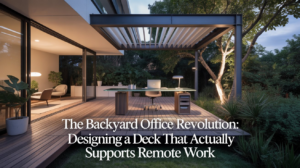
Remote work has permanently reshaped how homeowners use their space. Spare bedrooms became offices overnight, dining tables turned into desks, and patios started doubling as meeting zones. But in 2026, homeowners are thinking bigger.
Instead of squeezing work into existing rooms, they’re redesigning outdoor spaces to function as productive, connected extensions of the home. A well-planned deck is no longer just for entertaining. It can be a high-performing remote workspace if it’s designed intentionally.
Here’s what most homeowners overlook when building a “backyard office.”
Why Outdoor Workspaces Are Surging
The appeal is obvious. Natural light improves focus and mood. Fresh air reduces fatigue. Flexible environments increase creativity.
But working outdoors isn’t as simple as carrying a laptop outside. Productivity depends on three critical pillars: structural comfort, weather adaptability, and reliable connectivity.
Miss one of these, and the space becomes decorative instead of functional.
Structural Design: Stability, Shade, and Ergonomics
A productive outdoor office starts with physical comfort.
A deck designed for dining or lounging may not support the stability needed for work. Subtle vibration from foot traffic, uneven boards, or undersized framing can make typing uncomfortable over long sessions.
Homeowners planning a dual-purpose deck should consider reinforced framing for minimal movement, integrated pergolas or partial roof systems for glare control, built-in bench seating with ergonomic backing, and wind buffers for microphone clarity during calls.
Custom builders like US Quality Construction often design decks around how the space will actually be used, not just how it will look. When productivity is part of the goal, load planning, layout orientation, and shading become performance features rather than aesthetic upgrades.
Power and Connectivity: The Most Overlooked Element
This is where many outdoor workspace projects fail.
Homeowners invest in beautiful materials but forget infrastructure. Running extension cords across sliding doors is neither safe nor sustainable.
Instead, forward-thinking deck builds integrate weather-rated electrical outlets, concealed conduit for future tech upgrades, mounted WiFi access points or signal boosters, and smart lighting with app control.
Reliable internet is foundational. Video calls, cloud platforms, and large file uploads demand stable bandwidth. If your router sits at the opposite end of the house, signal degradation outdoors is inevitable.
Before building, evaluate router placement, mesh network compatibility, outdoor-rated networking hardware, and fiber availability in your area. The physical structure and the digital backbone must be planned together.
Weather Protection Without Losing Openness
Working outdoors sounds appealing until the first summer heatwave or light rain. A deck that supports remote work should include climate moderation strategies.
Strategic pergola slats, retractable canopies, or partial solid roofing can dramatically reduce screen glare and overheating. Positioning relative to prevailing winds improves comfort without fans. In some climates, ceiling fans rated for outdoor use can extend usability throughout the year.
Moisture management also matters. Composite decking materials resist warping and reduce long-term maintenance, especially important if equipment is frequently brought in and out.
When the deck functions as a workspace, durability becomes a productivity issue.
Acoustics and Privacy: The Hidden Productivity Factor
Noise is often underestimated.
Backyard environments include lawn equipment, neighbor conversations, traffic, and wind interference.
Design adjustments can help. Privacy screens can double as sound buffers. Strategic landscaping softens ambient noise. Fence enhancements and angled wall elements under pergolas create visual privacy while subtly improving audio quality for calls and recordings.
These refinements elevate the space from a casual patio to a professional environment.
Designing for Multi-Use Flexibility
The best backyard offices don’t look like offices.
They convert seamlessly from morning workstation to afternoon reading space to evening entertainment zone.
That flexibility requires thoughtful layout zoning. A dedicated power wall, clear desk placement zone, adjustable lighting layers, and hidden storage for quick transitions allow the space to adapt without feeling cluttered.
A contractor experienced in functional outdoor spaces will approach the design as an extension of the home’s workflow rather than a detached platform.
ROI: More Than Property Value
Outdoor living upgrades consistently rank among high-return home improvements. But when a deck also supports remote income generation, the return calculation changes.
A space that enhances productivity, mental clarity, work-life separation, and client-facing professionalism has measurable lifestyle value.
In competitive housing markets, properties with purpose-built outdoor workspaces may also stand out to buyers prioritizing remote flexibility.
Planning Checklist Before You Build
If you’re considering a deck designed for remote work, ask yourself:
Where will power come from?
How strong is my outdoor WiFi signal?
What time of day will I primarily work outside?
How will I manage glare and weather shifts?
Is the framing designed for long seated use?
Can the space evolve with future tech upgrades?
These questions turn a standard deck into a strategic lifestyle investment.
The Future of Connected Outdoor Living
As internet speeds increase and remote work stabilizes as a long-term norm, homeowners are rethinking square footage. The backyard is no longer secondary real estate. It’s functional territory.
A deck built with connectivity, comfort, and infrastructure in mind becomes more than an entertainment platform. It becomes a productivity asset.
The backyard office revolution isn’t about escaping indoors. It’s about expanding what home can do.